
Buildings make up most of a city’s built-up area. When well-designed, even a single building is enough to stand out with its attractive appearance. In a group, they constitute an even stronger presence as a visual feast for the eyes.
However, in our age of mega-sized shopping malls and multi-storey office complexes, it is very easy to overlook some of these aging, but otherwise quaint and, historical structures.
One such example is the Fair Park residential scheme in Ipoh, an area with a strong character and history of its own.
Fair Park is a British Colonial period housing scheme located right smack in the centre of Ipoh city, off-Jalan Kamaruddin Isa – formerly Fair Park Road. But when it was first built, in the 1930’s, it was to be found on the outskirt of Ipoh town. Just beyond it would be forests and kampong areas, including Kampong Kepayang Fair Park – my birth place.
When I was small, I remember going to the hairdresser’s in Fair Park, pillion riding on my Tok Hussein’s motorbike. We’d pass by the single row of wooden shophouses before passing through Fair Park itself. The hairdresser’s was just across the main road from the earliest section of Fair Park to have been built.
Those were the days. You can imagine, thus, why Fair Park has a special place in my heart. This place is inextricably linked to my Kampong Kepayang – physically, in name, as well as, the fond childhood memories it brings.
According to Ms Rosy Tan, a resident for 30 odd years, Fair Park was developed in 1939. The oldest section, which sits on an area of about 2 acres, comprises 60 terrace-housing units arranged in five parallel rows of 10 separate blocks.
It was designed by a British architect firm, Iverson & Co. It had a handsome design with modern facilities. All housing units have three bedrooms and a toilet. Each toilet comes with a flushing system – something of a novelty (not to mention a rarity) for houses back in the 1930s.
The houses also come with a chimney up on the roof. But it is for the cooking stove rather than a living area fireplace.
A concrete entrance canopy grace the front of the houses providing some shade and protection from rain. However, it is rather small compared to what we Malaysians are used to today. Nevertheless, the front façade have remained intact as none of the units have any additional structure to their canopies. This, to me, is quite amazing, when you consider that one of our favourite national past time is extending our houses.
I am not clear as to the architectural style of Fair Park. However, it was built and designed in the late 1930s when Art Deco was the in thing. To my untrained eyes, some traces of this can be detected in the form of the concrete canopies above the front windows.
Being the latest offering of an up-market housing area meant that Fair Park attracted mostly English tenants when it was first completed. In fact, if one were to flag down a rickshaw to go to Fair Park back then, one has only to mention “kee ah molau” – which means “English house” in Chinese – for you to be promptly taken there.
My Emak still remembers that, when she was making her way home from her primary school those days, she would often stop by along the way to play around with the Mat Salleh kids.
After Malaya’s independence, most of the Mat Sallehs left for Britain. However, Fair Park continued to be an affluent and exclusive community. The Mat Sallehs were soon replaced by rich Chinese towkays and prominent Ipoh professionals – doctors, lawyers and politicians. Heck, if there was a Bel Air for Ipoh in the pre-Merdeka days, it would have been Fair Park!
Alas, after almost 70 years standing tall, Fair Park is now being demolished to make way for new development. This, I sadly discovered last weekend when I was back in Ipoh to visit my parents.
A check around the neighborhood revealed conflicting answers as to what will be developed over Fair Park’s site. “A health centre” offered Ms Rosy Tan. Yet the local newspaperman was quite adamant that it shall be a multi-storey shopping complex.
Whatever stands in place of the old Fair Park, things would never be the same again for this part of Ipoh. And as the old English saying goes: “out of sight, out of mind”. Soon enough Fair Park will be forgotten and lost in history.
This need not have been the case. For if the authorities had been more sensitive to history, some research would have established the social and historical significance of Fair Park. Its architectural values could have been documented.
The place could have been conserved. Even if that was not possible, at least the documentations would have been useful for future generations as a record of Ipoh history, as well as, a homage to a piece of our heritage.

Traces of Art Deco features

Window details

Quaint: front elevation of a single unit

Green seperation in between blocks

Chimney for the cooking stove below

Side elevation of a block

The road dividing two rows facing each other. A cosy and relaxing atmosphere. Just imagine this space teeming with life and activities back in its heydays.

Side wall

Second floor. Notice the red brick used for construction. They are still in good form.

Close-up of front entrance. Notice the extension over the front door and window which is the original concrete entrance canopy.

Cooking area. I'm not sure what type of cooker was used. Charcoal? Firewood?

Winding staircase up to the second floor. Notice the small squarish tiles.

There are only three units left still with occupants. The rest have left to make way for the demolition job. This is the front view of Ms Rosy Tan's residence.

Sprightly and friendly Ms Rosy Tan

Ms Tan's beautiful front garden
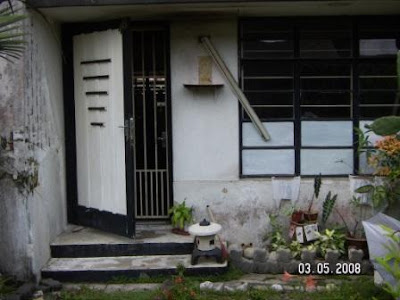
Close-up of Ms Tan's front entrance

View from inside Ms Tan's house looking out to her front garden

Some of Ms Tan's most valued belongings arranged on the floor of her living room. When we visited her, she was in the process of moving out. A small lorry duly arrived sometime later and the driver and his helpers started filling up their lorry with Ms Tan's things

Ms Tan's post box

Another resident was octogenarian, Mr Mak (right). He is seen here relating stories of how he has been hounded by workers of the demolition job contractors to move out as soon as possible. Window panes and light bulbs have been broken in order to intimidate him, said Mr Mak.

Mr Mak is a school bus driver and he lives alone. This is his trusted ride. "Dia umur sudah lima puluh tahun", said Mr Mak of his Mercedes Benz mini bus.

Scene of demolition job in progress

This is the view of a slightly newer section of Fair Park. This was built in early 1940s, according to my Emak. Another piece of heritage waiting to lost forever? I sure hope not

The Fair Park name signage by the side of the main road Jalan Kamaruddin Isa. How long will this continue to stand here? Forever, I hope. But for now, its farewell to old Fair Park.


 Buffalos roam freely in Gunung Lang country
 My bike taking a break during the heavy downpour. Also seen is motorcycle rider who is also taking a shelter from the rain


